“We have to win the World Cup”: Key quotes from Day Two of the CAF Strategy Conference in Cabo Verde
Posted by TWR Publications
7 hours ago
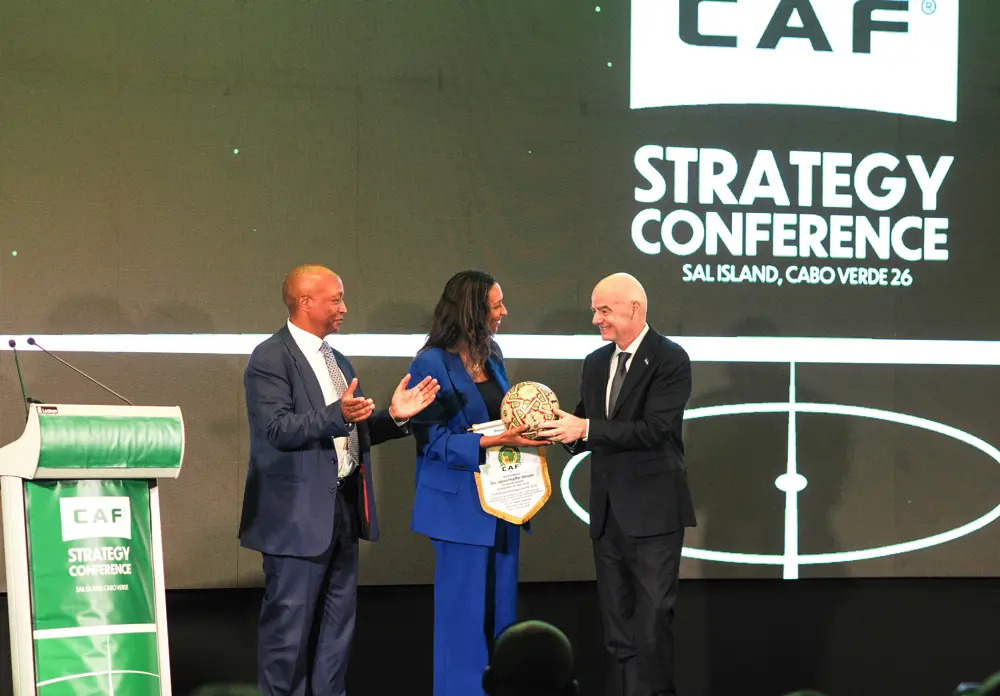
African football’s ambition to turn its record FIFA World Cup 2026 performance into lasting progress dominated the opening addresses on Day Two of the CAF Strategy Conference in Santa Maria, Sal Island, Cabo Verde.
CAF President Dr Patrice Motsepe, Cabo Verde Head of State Dr Janira Hopffer Almada, FIFA President Gianni Infantino and Cabo Verde Football Federation President Mario Semedo addressed delegates as the Conference moved into its main strategic discussions.
Their messages centred on investment, stronger Member Associations, African coaching and technical development, infrastructure, women’s football and the need to convert Africa’s football talent into sustainable results. Cabo Verde’s historic World Cup campaign also featured prominently, with speakers presenting the Blue Sharks’ success as evidence that organisation, investment and belief can allow smaller nations to compete on the global stage.
Motsepe placed results, investment and stronger football structures across all 54 Member Associations at the centre of his message, insisting that African football must now move beyond good intentions. “There is a big gap between good plans, good intentions and what we do practically in terms of investments and results. We are judged by results.” He said CAF’s priority was to ensure that progress reaches every association on the continent rather than being concentrated among a handful of successful nations.
“What are we going to do today, next week and next month to make sure that the quality of football in each of our 54 Member Associations is world-class? That is where it starts.” Motsepe also made clear that Africa’s long-term ambition should go beyond strong World Cup performances. “We have to win the World Cup. We are going to win the World Cup. One of the nations from Africa will win the World Cup.” And he challenged African football to translate years of optimism about the continent’s potential into measurable outcomes.
“There has been lots of talk over the last 30 or 40 years that ‘it is the time of Africa’. Our young people are saying: show us tangible, quantifiable results that reflect that it is indeed the time of Africa.” Dr Hopffer Almada used Cabo Verde’s remarkable World Cup story to argue that size and resources should not determine a country’s football ambitions. “Cabo Verde reached the World Cup and today the World Cup comes to Cabo Verde. There are no coincidences: there is work, commitment, discipline, belief, perseverance and dreaming.”
She said the Blue Sharks’ success reflected a broader lesson about what can be achieved through organisation and confidence in local capacity. “Talent without structure cannot become sustainable results. We have to trust the knowledge that is created on the continent and create conditions so that Africans can lead major projects in Africa.” Looking beyond the celebration of 2026, she challenged delegates to build systems capable of producing excellence repeatedly.
“We are not here just to celebrate what happened in 2026. We are here to ask: what now? How do we transform an extraordinary generation of players into an extraordinary structure of development?” She also delivered one of the Conference’s strongest messages on women’s participation in football.
“We cannot speak about development without talking about the participation of women. Women must take their place as referees, coaches, players, doctors, journalists and decision-makers — in environments of respect, dignity and equality.”
Infantino highlighted the scale of Africa’s improvement between the 2018 and 2026 World Cups, describing the change as evidence of the work being undertaken across the continent. “In 2018 there were five African representatives and zero qualified for the knockout phase. Now nine out of 10 have qualified — 90% in only eight years and two World Cups.” He said football authorities had a responsibility to ensure that birthplace did not determine whether a young person could fulfil their potential.
“A child’s opportunity cannot be limited by the place where he or she is born. We have to continue investing in infrastructure, coaching and competitions so that talent has an opportunity to shine.” Infantino also highlighted infrastructure improvements, saying significantly more African countries were now able to stage international matches at home.
“Two years ago, 26 African countries could not play their matches at home. Now 40 can play at home, and our common objective is for every African nation to be able to play its home matches on its own territory.” His broader message was that Africa already possesses the fundamental ingredients required for further progress.
“African talent is shaping world football. The talent is there, the passion is there, the infrastructure is coming and the competitions are coming. We have to provide the opportunities for this talent to shine on the global stage.” For Semedo, hosting the Conference represented both a landmark moment for Cabo Verde and an opportunity for African football leaders to learn from each other.
“It is very emotional for me to be before my friends, the African football family, here in Cabo Verde.” He praised the decision by CAF to bring its leadership together for a broad strategic conversation about the continent’s football future.
“We congratulate CAF President Dr Patrice Motsepe for this extraordinary initiative to promote dialogue and reflection on African football with the participation of all the members.” Semedo said dialogue was fundamental to progress and praised CAF’s attempt to place Africa at the centre of conversations about the global game.
“Dialogue is always an intelligent option, and your vision to bring Africa to the centre of the debate on the future of world football is evidence that your leadership has been crucial for the growth of African football.” He also urged delegates to ensure that the meeting produced ideas capable of making an impact beyond Cabo Verde.
“We hope that throughout these days we can share experiences and that everyone can take home inspiring ideas for our federations and our respective countries.” The messages from the opening session converged on one central theme: Africa’s historic 2026 World Cup showing should be treated as a platform rather than an end point.
With the continent now looking towards 2030, the challenge outlined in Sal is to turn talent, growing investment and recent results into sustainable structures capable of keeping African football competitive at the highest level.
Tags
CAF Strategy Conference
FIFA World Cup 2026
Featured News
Category
Tourism & Diaspora
Sports
News
Music
International News
Health Tips
Events
Entertainment & Arts
Editorial
Culture & Tradition
Business & Tech
Have Any Question?
If you have any questions, feel free to contact us:
031 229 5629
info@twradiogh.com