The Making of Modern Ghana: From Gold Coast to the Jewel of West Africa
Posted by Enoch Nyamson
1 month ago
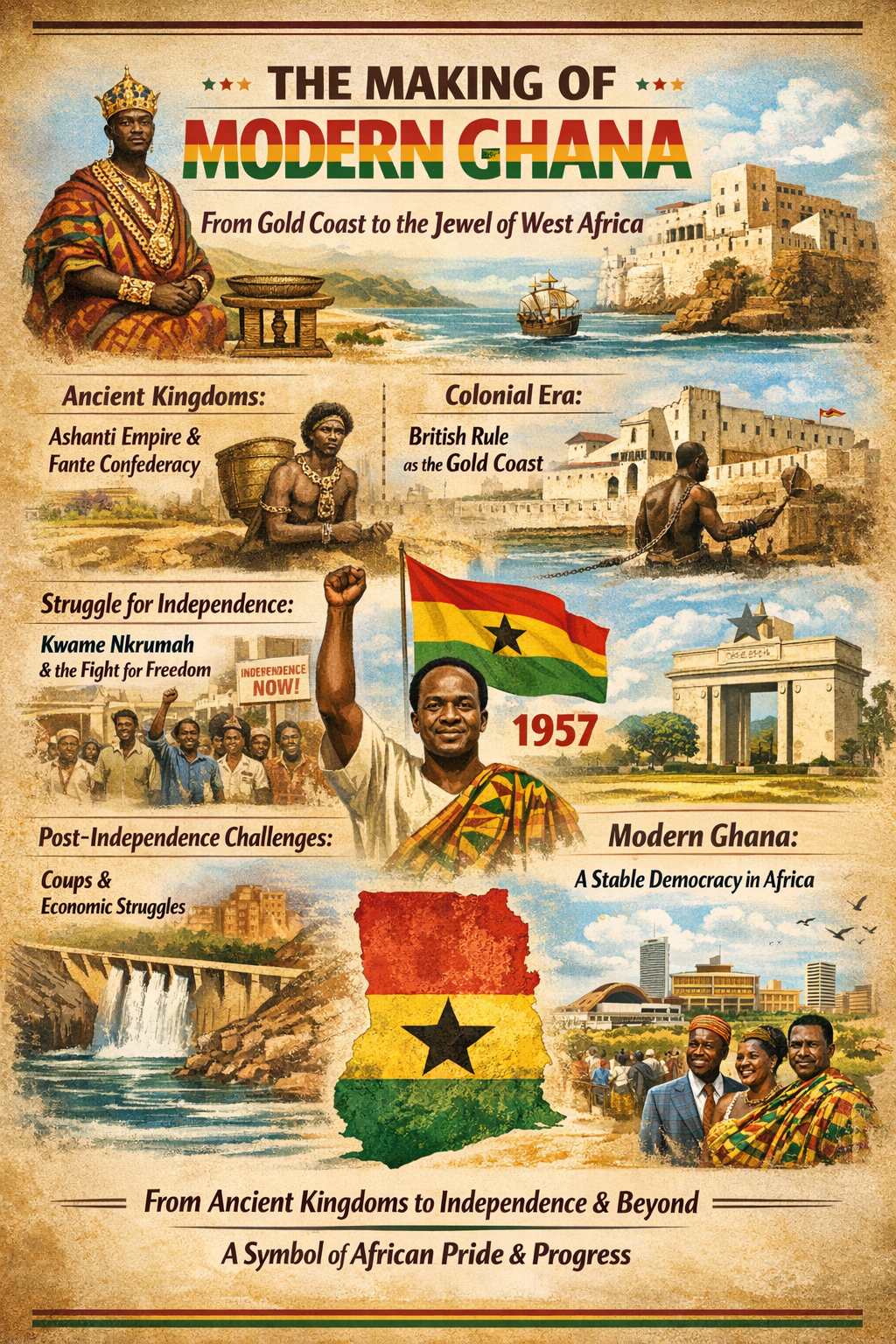
Ghana, often called the “Gateway to Africa,” has a rich and complex history that has shaped the nation we see today. Its journey from a cluster of ancient kingdoms to the modern democratic state is marked by resilience, cultural richness, and the struggle for self-determination.
Long before colonial powers arrived, the region we now know as Ghana was home to several sophisticated societies. The Kingdom of Ghana (not in present-day Ghana) influenced trade, while local entities like the Ashanti Empire and the Fante Confederacy thrived in the central and southern regions. These kingdoms had complex political systems, rich cultural traditions, and were engaged in regional and trans-Saharan trade, exporting gold, kola nuts, and ivory.
The arrival of Europeans in the late 15th century marked a new chapter. Portuguese, Dutch, Danish, and British traders established forts along the coast, such as Elmina Castle and Cape Coast Castle, to control trade—initially in gold, and later tragically in slaves. By the 19th century, the British had consolidated control over much of the region, officially naming it the Gold Coast. Under colonial rule, local governance was disrupted, traditional authority was challenged, and the economy was oriented to serve British interests.
The 20th century brought rising nationalist movements. Figures like Kwame Nkrumah, educated abroad and inspired by Pan-African ideas, emerged as leaders advocating for self-rule. Political organizations such as the United Gold Coast Convention (UGCC) and later the Convention People’s Party (CPP) mobilized mass support, leading to a wave of protests, strikes, and civil disobedience.
In 1957, the Gold Coast achieved a historic milestone, becoming the first sub-Saharan African country to gain independence. Nkrumah became the first Prime Minister, and later the first President of the newly named Republic of Ghana. Independence symbolized more than political freedom
Ghana’s early years were marked by ambitious development projects, like the Akosombo Dam, aimed at industrialization and modernization. However, economic difficulties, political instability, and military coups such as the overthrow of Nkrumah in 1966 tested the young nation’s resilience. Despite setbacks, Ghana gradually stabilized, adopting democratic governance in 1992 with the promulgation of a new constitution.
Today, Ghana is a vibrant democracy, known for its political stability, relative peace, and rich cultural diversity. From the bustling streets of Accra to the historic sites in Cape Coast and the cocoa farms in the Ashanti region, Ghana balances modernity and tradition. It has become a hub for education, tourism, and trade in West Africa.
Tags
Ghana
Featured News


Category
Tourism & Diaspora
Sports
News
Music
International News
Events
Entertainment & Arts
Editorial
Culture & Tradition
Business & Tech
Have Any Question?
If you have any questions, feel free to contact us:
031 229 5629
info@twradiogh.com