London Bridge in Cape Coast: A Local Crossing Shaped by Geography and Colonial Memory
Posted by Enoch Nyamson
1 day ago
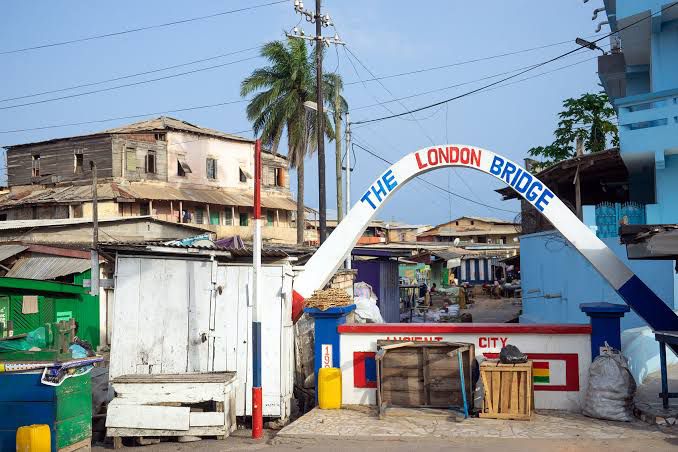
The story of “London Bridge” in Cape Coast is not about a single monumental structure, but about how geography, colonial contact, and local experience came together to create a place name that has endured over time. Like many features in Cape Coast, it reflects a deeper narrative one of adaptation, interaction, and the blending of worlds.
To understand its origin, you have to begin with the physical landscape of the town. Cape Coast developed along a coastline defined by uneven terrain, tidal influence, and water bodies such as the Fosu Lagoon. Parts of the town, especially in earlier periods, were separated by streams, marshy ground, and seasonal water channels. Moving from one section of the settlement to another was not always straightforward. As a result, small bridges, wooden crossings, and later simple causeways were constructed to make movement easier for residents, traders, and officials.
These crossings were functional rather than monumental. They were built to solve immediate problems how to get across water, how to link neighborhoods, how to maintain the flow of daily life. Yet, over time, certain crossings became more prominent because of their location, usage, or proximity to important parts of the town.
It was within this setting that the name “London Bridge” emerged.
Cape Coast was one of the earliest and most significant points of sustained contact between West Africa and Europe. With the establishment of Cape Coast Castle, the town became a major center of British administration, trade, and cultural exchange. British officials, merchants, missionaries, and educators lived and worked there for centuries, bringing with them not only political and economic systems but also language, memory, and references to places back in Britain.
One of the most recognizable landmarks in Britain is the London Bridge. For the British, it symbolized connection, movement, and urban life. When they encountered or helped construct crossings in Cape Coast no matter how modest it was natural for them to draw comparisons with familiar structures from home. In everyday speech, a local crossing could easily be referred to, half-seriously or descriptively, as “London Bridge.”
At the same time, the people of Cape Coast were not passive recipients of these influences. Names introduced during the colonial period were often adopted, adapted, and localized. What may have started as a casual or foreign reference gradually became part of the town’s own vocabulary. Over time, “London Bridge” lost any direct association with the actual bridge in England and became a distinctly local place name, understood and used by residents in their own context.
There is also a practical dimension to the naming. The crossing referred to as “London Bridge” served as an important link within the town connecting areas, facilitating trade, and supporting daily movement. Like its namesake in London, it functioned as a point of transition, a place people passed through regularly. This functional similarity reinforced the appropriateness of the name, even if the scale and structure were entirely different.
As the town evolved, so did the meaning of “London Bridge.” It became more than just a physical crossing. It turned into a social and spatial reference point a place people could mention when giving directions, arranging meetings, or describing parts of the town. In this way, it entered the mental map of Cape Coast, shaping how residents understood and navigated their environment.
What makes “London Bridge” particularly interesting is what it represents in the broader story of Cape Coast. Unlike indigenous symbols such as the crab, which emerged from the natural environment and local philosophy, “London Bridge” reflects historical contact and cultural layering. It is a reminder that Cape Coast has long been a meeting point of worlds African and European, traditional and colonial, local and global.
The name captures a subtle but important process: the way foreign elements are absorbed into local life and given new meaning. It shows how colonial influence extended beyond formal institutions into everyday language and geography, while also demonstrating the agency of local people in reshaping those influences into something their own.
In the end, “London Bridge” in Cape Coast is not significant because of its size or architecture. Its importance lies in what it tells us about the town itself. It speaks of a landscape shaped by water and the need for connection. It reflects a history marked by interaction and exchange. And it stands as an example of how place names can carry layers of meaning \linking the local to the global, and the past to the present.
Like many aspects of Cape Coast, it is simple on the surface but deeply rooted in history.
Tags
“London Bridge”
Cape Coast
Featured News
18 hours ago




Category
Tourism & Diaspora
Sports
News
Music
International News
Events
Entertainment & Arts
Editorial
Culture & Tradition
Business & Tech
Have Any Question?
If you have any questions, feel free to contact us:
031 229 5629
info@twradiogh.com